After a disappointing wet, half-day
visit to Venice over 20 years ago, I wanted to return and see this fascinating
city, described as an open-air museum - hopefully in a better light. Venice is
not an island but was originally built upon wooden stakes driven into the
swampy ground – and is now sinking at a rate of 1mm each year. It has a network
of canals, the Grand Canal being the most important and the city's "main
road", as well as narrow ones only a few feet wide.
There are thousands of
buildings facing onto these canals, some dating back to the 13th century and
many of their facades have now been beautifully restored. I had been advised to
get a 3-day pass for the Waterbus (Vaporetto) at 40 Euros, this was easily
obtained at a kiosk by the main bus station, and it was definitely the best
idea. I travelled down the Grand Canal, marvelling at everything I could see –
especially the bright green water, the ornate buildings and the volume of traffic
on the water.
Although I didn’t arrive at my hotel until 6pm, I couldn’t wait
to get out exploring. As the hotel was very central, it only took 10 minutes to
walk to St Mark’s Square, which wasn’t too busy, as most of the day-visitors
had left. The Basilica at the far end is so impressive with its golden arched
façade, the exquisite Doges Palace next to it and the imposing Bell Tower
standing proudly in front of them.
The Square is a huge open space, surrounded
by covered walkways with shops and restaurants – some even had musicians playing
outside to entertain their guests – it was a pleasure to be part of these romantic
surroundings.
I had wondered about buying a ticket to go up The Bell tower
before I arrived, but as they had timed slots, I wanted to see what the weather
was like – and that evening it was perfect. As most of the day-visitors had
left, I only had to queue for 5 minutes, pay 8 Euros, and board the elevator
that takes you the 100 metres to the top. I had the most stunning views of the
entire city and surrounding lagoon, from each of the 4 sides there was
something different to see, and the early evening light was perfect.

The Tower
was built on Roman foundations, originally a lighthouse in 1173, then a watch
tower, and in 1513 it was restored following an earthquake; but it collapsed in
1902 and was reconstructed to resemble the 1513 version. At the top, there are
5 huge bells, each used to have a specific function, ringing out for work,
meetings and even executions; and there is a plaque commemorating Galileo who
used the tower to observe the stars. Above the belfry is a pyramid-shaped spire
and a gilded statue of the Angel Gabriel which acts as a wind vane. I was so
pleased that I had been able to go up this Tower and get a real sense of Venice
from up above.

Next, I crossed Accademia Bridge (which was being restored) to
Zattere, a pleasant, peaceful waterfront promenade within the Dorsoduro
district, with great views over the lagoon, and many people dining out. From
one of the pathways I saw Squero di San Trovaso, a 17th century boatyard next
to San Trovaso Church, it is one of 3 remaining gondola repair yards in the
city and the oldest.


The highly skilled gondola builders originated from the
Italian Alps, and they have been making these traditional boats, in a Tyrolean
style for generations. The traditional structure of a gondola requires 8 types
of wood and according to a 16th century law must be painted black. Today the
boatyard is used more for repairs than for construction, servicing the 300 –
400 working gondolas. As darkness fell, quicker than I expected not helped by
the tall buildings, I headed back to my hotel, through the maze of alleyways,
bridges, and busy squares – feeling happy that I had made the most of my evening. Early next morning, I headed out, through a more peaceful St Mark’s Square –
where there were only people with cameras wanting a serene shot of area, or
couples in Wedding outfits wanting a romantic picture.


As well as enjoying the
area with fewer people about, it was great to see the empty colonnades
surrounding the square. I caught a Vaporetto, outside the Doges Palace and
headed to some of the outlying islands. First stop was Murano, covering an area
of less than a square mile, it is a series of 7 islands connected by bridges
and lined with small cafes and shops – especially glass-ware shops. Murano is famous
for its glass-making, having factories with demonstrations on how glass is made,
and the different techniques used, some since Egyptian times.
Some of these buildings
looked very run down and not very inviting, whereas the little shops were
fascinating – I loved seeing all the handmade glass, in particular the ornate
chandeliers and unusual items; and an incredible blue starburst glass sculpture
in Campo San Stefano.


It felt peaceful here away from the hustle of the city,
but there was less to see than I expected. There are several old churches, Santa
Maria degli Angeli, Basilica dei Santa Maria e San Donato, Church of Saint
Peter the Martyr and Church of Saint Stephen with a clock tower. Murano does
have a fascinating history….. In the 13th century, medieval 'Health and Safety'
was introduced; when Venice's Government realised that the open furnaces used to
make glass were a serious fire hazard to the confined island, and an
uncontrolled fire could have completely wiped Venice out. So, it was decreed
that Venice's glass manufacture should be moved to the less built-up island of
Murano; here the industry prospered, and its reputation spread worldwide. Glass
Window panes made in Murano were considered the largest and clearest in Europe
and for a long time, all mirror production was exclusive to Murano.


I only
spent an hour on this island, then headed for the white lighthouse, that is the
Vaporetto stop, 'Faro', to go over to Burano. This smaller island is famous for
its picturesque, brightly coloured fishermen’s houses with small canals acting
as thoroughfares, many little alleys and a few paved squares.
Burano was enchanting;
the sun was shining; the sky was blue, and around every corner was another striking,
vibrant photo opportunity. If someone wishes to paint their home here, they
must send a request to the government, who allows only certain colours to be
used.
I passed the Church of San Martino,
with its leaning bell tower, the Museum & School of Lacemaking, and came to
Piazza Galuppi - with stalls and shops selling linen, lacework, and intricate glass
items, and several cafes.
I stopped for a picnic lunch along the water’s edge,
which was so serene; and had superb views of neighbouring islands, and with the
Alps in the distance – it was an absolute delight. This charming island is a
must for anyone visiting the area – it had completely captivated me. After crossing
the bridge to Mazzorbo, I passed an ancient vineyard and caught the Vaporetto
over to Torcello - having no idea what I was going to find there. It is a very
different island in every way, I walked along a wide canal for 10 minutes feeling
as though I was in the English countryside.
I passed a couple of tavernas and
touristy stalls and at the end of the waterway there is a museum, some old
ruins (the 5
th century throne of Attila the Hun), Santa Maria
Assanta cathedral (the oldest church in Venice built in 639AD containing the
oldest mosaics in the area), and the adjacent 10
th century church of
Santa Fosca.
I didn’t spend long on Torcello, but it had been interesting to
see; then I headed back to Venice passing several small islands that have sadly
succumbed to the ocean.
Once back in the city, I went to Rialto Bridge - the oldest,
most famous and most beautiful of the bridges that cross the Grand Canal, and
an important crossing point to the nearby Rialto market. The bridge has steep
ramps from both shores which meet in the middle, 3 walkways (a wider one in the
centre and 2 overlooking each side) with 2 rows of shops between the walkways;
and it was built high enough for ships to sail underneath.
I found the best
view was slightly down river, where I could fully appreciate the design with
its arched openings and beautiful balustrade – truly one of the most elaborate
stone bridges I have ever seen.
I continued back to St Marks Square and decided
to go into the Basilica as the queue wasn’t very long (only 10 minutes). It was
free to get in and I didn’t need to buy a skip the line ticket - remember no
backpacks are allowed inside. St. Mark's Basilica is Venice's most famous
church; in 829 the body of St. Mark was smuggled out of Egypt and transported
from Alexandria to Venice to rest here. Nowadays the building is full of sacred
images and mosaics, one of the highlights being the mosaic that narrates the
life of St Mark and episodes from the Bible and is depicted in the oldest known
exterior mosaic in the world, above the cathedral's front doors.


The entrance
lobby has a marble mosaic floor from the 11th and 12th century and gilded
ceiling mosaics – they were my favourite part. I did find the rest of it rather
dark and everyone was hurried through – so I was disappointed and glad it
hadn’t cost me to go inside – the outside was far more impressive. To finish my
day off, I went to a Baroque Opera Concert by The Orchestra “I Musici Veneziani”
at the Scuola Grande De San Teodoro; I had no idea what to expect but it felt
like something I really must do whilst in Venice.
The theatre is described as the most
Prestigious Concert Hall in Venice, with its walls and ceiling adorned with 17
th
and 18
th century paintings, the cast were all dressed in colourful
18
th century costumes and the variety of music and singing was
absolutely mesmerizing. I enjoyed it immensely and can highly recommend the
experience.
When I left the theatre at 10pm, the streets were still bustling,
so I didn’t feel worried walking back to my hotel – still humming the arias I
had been listening to all evening. Next morning, I was up early ready for my
pre-booked Secret Itineraries Tour of the Doges Palace. I had read that it was
one of the best things to do in Venice – so I was hoping that it lived up to
its reputation. Seeing the Palace from the outside is a fabulous sight, the
white façade, the intricately designed arches – and its position overlooking
the lagoon – for me, it was captivating and so exquisite.
The Palace was
originally founded in the 14th century with other sections added on over the
years. In the 17th century the prison was separated from the palace and
constructed across the “Bridge of Sighs”; so, prisoners would have been
sentenced in the palace courtrooms and then walk across the bridge to the
prison or to their execution, and on their way, they would sigh (at the sight
of freedom)!
The Tour I took started in
the old Well cells (by the water) and went up more and more narrow staircases,
seeing other cells that were lined with wood (although these were more
punishing - as the creatures that lived in the wood ended up feeding off the
prisoners!).
We went through various levels of Doges’ offices, learning about the
1,000-year-old political and justice system of the Venetians. As well as seeing
ancient prison cells (including the cell where Casanova was imprisoned); secret
passageways, the torture chamber; and the attic that now houses ancient battle
gear – there were some marvellous views when we were at the very top of the
building and could almost touch the underside of the roof.
After this tour, I
was free to see the rest of the Palace on my own and could not believe the
grandeur of the rooms. From the court-yard you go up to the Doge’s Apartments
on the first-floor, where each room is more elaborate than the previous. There
are frescoes, carved wooden ceilings, marble reliefs, paintings and numerous
works of art, so much gold; and hidden passageways which connect different
rooms.
I followed the signs to the prison, which was a different section than I
had seen earlier and walked through the enclosed Bridge of Sighs, imagining the
last view a prisoner would see, as he was sent to his cell or to his death. The
bridge was built in 1602, made of white limestone, with two small windows on
each side, and sculptured faces each with a sad or angry expression.
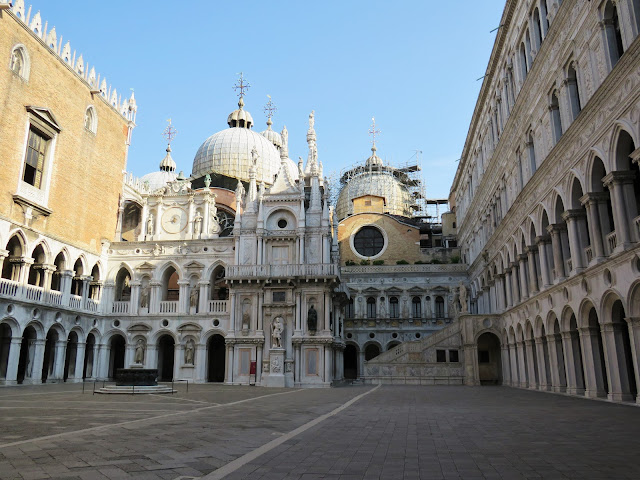
Finally,
outside in the courtyard, home to the statues of Neptune and Mars which guard
the Giants' Staircase, my time at the Palace was over. It had been a wonderful
morning, I was astounded with all I had seen – I would highly recommend
visiting.

When I left the Palace, the waterfront area was heaving with tourists
(I had seen 2 cruise ships arrive earlier that morning), so I walked the few yards
and caught the Vaporetto to Venice Lido. It passed along the waterfront
promenade with hotels, restaurants, shops and some fabulous arched bridges. I
also saw one side of The Arsenal, which used to be an important complex of
shipyards, built about 1104 and remained operational until the end of the
Republic in 1797. It declined in importance and today it is used as a naval
base, a research centre, and a centre for the preservation of historic boats. After
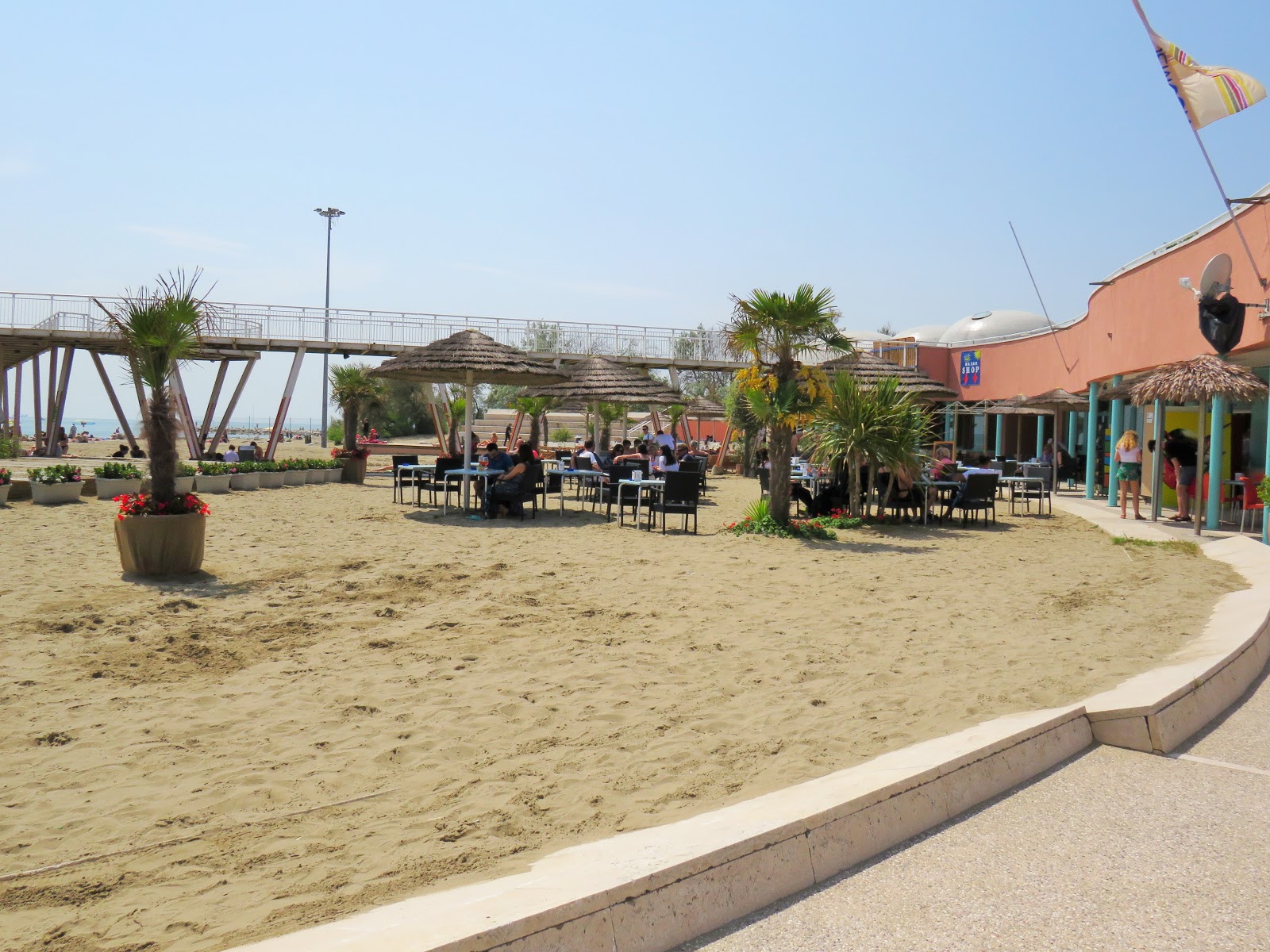
only 15 minutes I reached the Lido; a long island that separates the Venetian
Lagoon from the Adriatic Sea, with 11 kilometres of sandy beaches.

I headed
down the main street, that reminded me of other seaside towns (it didn’t feel
like I was in Venice anymore), lined with shops and eating places; and it
wasn’t long before I came to the seafront – a flat beach and calm ocean as far
as I could see.
Many sections of the beach are private, but the first part you
arrive at is the Blue Moon Public beach with its kiosks, sunbeds, parasols and
too many people.
So, I walked further along until I found a quiet stretch of
sand and had a much-needed rest, before paddling in the clear ocean all the way
back to the Blue Moon section. It was so nice to be away from the hustle and
bustle of the city, my tired feet appreciated the cold water, and it would have
been perfect if the shallows had been sandy – rather than crushed shells which
weren’t easy to walk on.
It was strange being in a part of Venice where you had
to actually look out for cars and motorbikes, and where you weren’t jostling
with people for a bit of space.
A few
hours, and an ice cream later, I found myself back on the Vaporetto - and the
views coming back into the City were wonderful – the shots of Venice that are
in every guidebook.
This time I alighted at the Giardini Pubblici Biennale
(created by Napoleon), this garden was very disappointing, with a few statues,
trees, bushes, grassed areas, although there were some toilets - and I didn’t
stay long. Deciding that I needed a sit down (as the Vaporetto’s I had been on
were so crowded that I had to stand all the time), I caught the next one that
wasn’t too busy, found a seat outside, and enjoyed the ride all the way up the
Grand Canal, soaking up the atmosphere of my surroundings.
I had intended staying
on for the return trip, but was told to get off, so I decided to walk through the
San Polo district. I saw the Leonardo Da Vinci Museum, which was next to the
Church of San Rocco (originally built as a response to a plague which overtook
the city in 1478).
I had been recommended to go into the nearby Basilica di
Santa Maria Gloriosa dei Frari - which is reputedly one of the greatest
churches in the city. The Franciscans originally built a church here in 1250, but
over the years it has been completely rebuilt and enlarged as a Gothic-style
church with a plain brick exterior, although it still has the campanile which
was completed in 1396. It was only 3 Euros to get in, and worth every cent.
The
interior is expansive and flooded with natural light from the windows,
everything appeared to have a pinkish hue due to the orange and white marbled
floor and the light walls. I enjoyed this more than the inside of St Marks. The
church has an amazing choir screen, the only remaining rood screen in Venice –
fabulous wood carvings.
Throughout the church, there are various paintings and
pieces of art, in particular the Madonna di Ca'Pesaro by Titian (the most
important member of the 16th-century Venetian school of painting - who died of
the plague in 1576 and was entombed in the church). To save my legs I hopped on
the next Vaporetto for a few stops, until I arrived at Santa Maria Della Salute,
a minor basilica but one of the most iconic landmarks, which appears on so many
Venice postcards.
A beautiful domed building almost at the end of the Punta
della Dogana, overlooking St Mark’s basin – the most perfect spot. It was free
to get inside and although there was a service going on at the far end of the
church, it was well worth a visit.
From here I followed the flat walkway
(Fondamenta) all the way around the triangular point, with views back up the
Grand Canal, St Marks, the Doges Palace, and San Giorgio Maggiore opposite (originally
known as The Island of Cipressi, as it was originally covered in vineyards and
cypress trees, until a Benedictine monastery was built there in 982).


I
continued along to the Zattere, where I stopped for something to eat at a
delightful restaurant overlooking the Canale Della Giudecca in the sunshine. I
watched as 2 cruise ships passed, hoping that Venice would now become more
peaceful like it was earlier in the morning. If possible, you really do have to
see as much as you can either first thing in the morning or at the end of the
day – especially if you don’t like crowds. I made my way back to the hotel, via
St Mark’s Square and the Doges Palace again - it does have this magnetism! I
couldn’t believe all I had seen in my short stay. Venice had surprised me, it
was busier than I expected, but wasn’t as expensive as I thought – getting the
Vaporetto pass was definitely the best thing I could have done. It enabled me
to see so much more than I would have done on foot – even though I had walked
31 miles over the weekend (and been on 11 boats!). I didn't get to go on a gondola, but you can go over the Grand Canal in one for only 2 Euros - look out for the special crossing points.


On the way back to the bus
station next morning, a normal working day, I was fascinated to see hundreds of
small boats taking every manner of essentials into the city. As well as food,
drinks, clothing etc, there were boats full of flowers, of building materials
(including a cement mixer!) and of course the incoming mail. It is hard to
imagine how every single commodity is carried into and around here by small
boat – another secret of this incredibly complex city. I had loved my time
here, it had been absolutely perfect, and I now had the most wonderful memories
of this captivating city.