Svalbard 2010

To reach
Longyearbyen, I had to fly via Oslo, and Tromso; along the Norwegian coastline,
with its pale blue ocean – dotted with tiny icebergs! As the plane came in to
land, over the Icefjord of Spitzberg – the scenery was absolutely breathtaking.

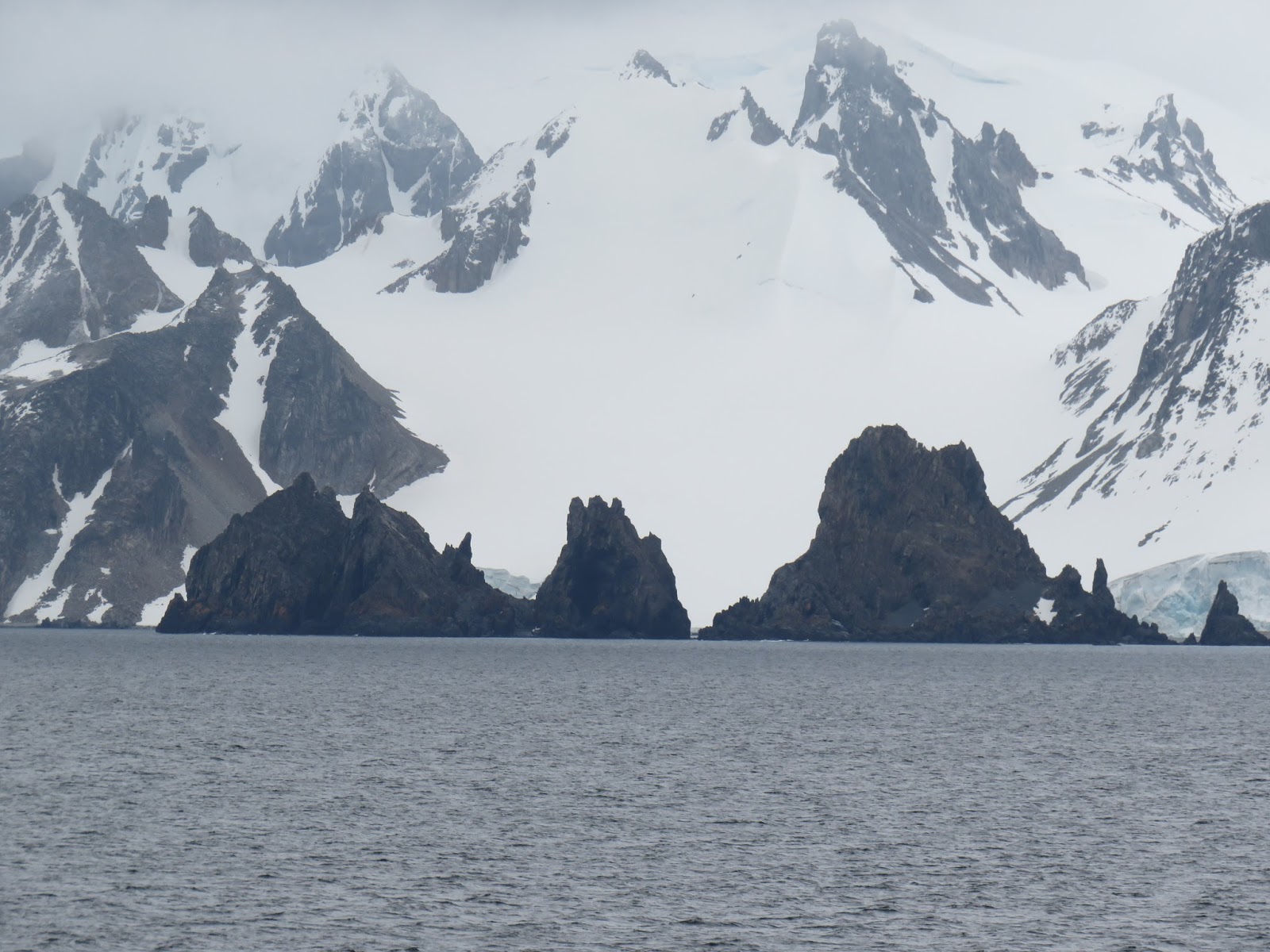
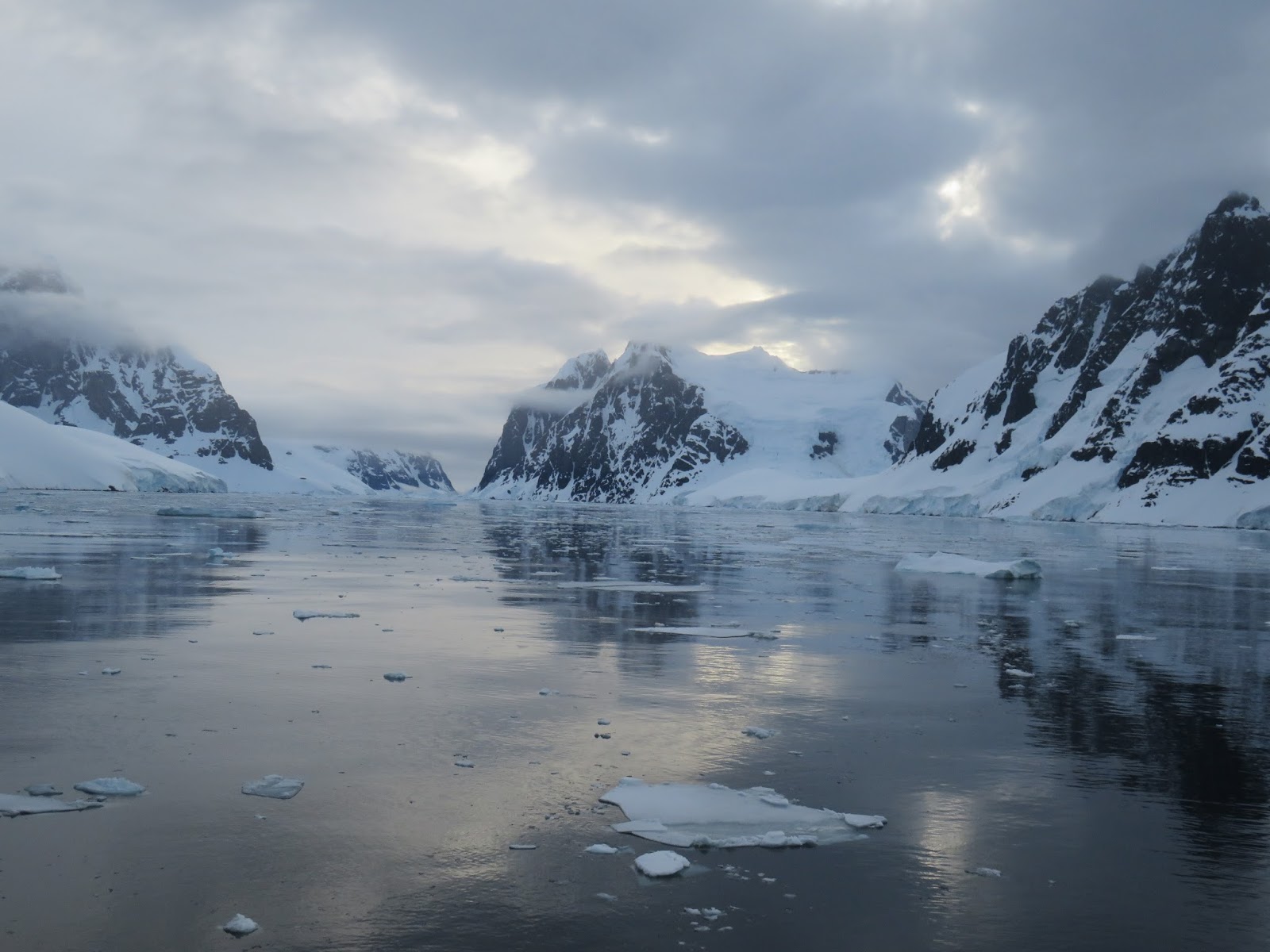
The mountains were completely different to anything I had ever seen - the snow on top of them came down the sides in uniformed patterns, covering the granite rock beneath. The water of the fjord was mirrorlike, with countless shades of blue and green mixed together.

It was one of the most picturesque sights at an airport I have ever seen! I was expecting a dull, drab place – nothing like this magnificent, impressive scenery. I was taken to the Spitsbergen Hotel “On the Hill” with fabulous views down into Longyearbyen, as well as above - to the Lars and Longyear Glacier. Unusually everyone had to take their shoes or boots off when they entered the hotel – and leave them by the front door! After a welcome meeting I decided to go exploring!

Different coloured wooden houses were built in rows like barracks; and there were hardly any cars about, but every house had skis and skidoos outside (together with sledges/trailers).


The sides of the road (a track really) was dotted with bog cotton and small yellow flowers (Svalbard Poppy) growing out of the shingle. There was a stuffed Polar Bear by some shops; and I hoped that, that wouldn’t be the only one that I saw on this trip!

Longyearbyen is the largest town on the island of Spitsbergen; home to mainly miners and researchers from all around the world. Spitsbergen used to be the name of the whole area, but it is now the name of the largest island of the Svalbard Archipelago. It is 1000 kilometres from the North Pole, at a similar latitude to the most northern point on Greenland – the most northerly habited place on earth. At the time of year I went, (July) it was permanently light - from 19th April until 23rd August. After dinner, as it still looked as though it was the middle of the day, I went another walk - up the hill this time. I had been told to keep within the town limits, due to constant danger from Polar Bears - if you went any further than this you were advised to carry a firearm. The local newspaper had reported a Polar Bear came down to the town only last week and had been scared off, with warning shots by the local police. Although I was still within these limits, there was hardly anyone about and I did feel slightly nervous. I headed up the steep hill towards some coloured buildings. Below the glacier ahead, I could see remnants of a ramshackled old mine – looking as though it could topple down at any minute.

I reached the buildings, which were hostels, and realised this was the edge of town. The road had just stopped, and all that was left ahead was shale, shingle and skidoos - parked up for the summer! I could not believe this was the outskirts of the town. I didn’t hang about; I took some photographs and started back down the hill - following the meltwater gushing down from the glaciers above. The day had been so much more interesting than I expected, and now I couldn’t wait for tomorrow. I closed my curtains at 10.30pm; it could have been lunchtime – thank goodness for blackout curtains! When I woke the next morning, I thought I was dreaming! There were two stumpy-legged Svalbard reindeer outside my bedroom window.

After breakfast I walked all the way down the hill, passing a church and a strange metal looking building – that reminded me of “Star Wars” – something from the old mines!

I headed to where several ships were moored and kept going along the track leading out of town. There were so many birds - eider ducks, geese, gulls and Arctic Terns (nesting only a few feet from the path). They had flown all the way from Antarctica to breed and were protecting their nests ferociously - proving a real problem – they kept being dive bombing me.

I ventured as far as one of the husky dog compounds before the weather turned, and a cold wind began blowing; so, I headed back to my hotel just in time for lunch; and then joined the afternoon guided coach tour. We visited the Polar Museum, with replicas of life-sized Arctic animals, as well as exhibitions on wildlife, mining, history and conservation. We were also taken a drive, stopping on the outskirts of town, and saw a road sign with a Polar bear on it!

The last stop was a Gallery containing impressive paintings of the region, as well as unusual handmade souvenirs. The Guide told us that all the buildings were built on metal poles, with the floor level 10 feet off the ground. They had to be built this way due to the constant permafrost in the ground and I thought it was to let the melting water run underneath them! The tour ended at 5pm, when it was time to board our ship the MS Fram.

This ship was built in 2007 and was well equipped with many modern amenities including a fabulous observation lounge, a gym, a sauna and 2 outdoor heated Jacuzzis! It was named after the strongest wooden exploration ship ever built – the Fram (used by the explorer Amundsen in the late 19th century). Today’s ship is only 114 metres long, rather small in comparison with luxury liners, but this ship is built for expeditions – not relaxation and pampering. All of its 225 passengers had come for an adventure and after our welcome briefing, we were all given with a new jacket, and were excited about what was in store for us. We set sail at 6pm, and after 3 hours sailing down the calm Icefjord, we arrived at the old Russian coal-mining town of Barentsberg. A town is probably the wrong word, as it only consists of a few hostel-type buildings, a hotel, a museum and a souvenir shop.

The ship docked at the quayside and after walking up 260 steps, we were given an introduction by a Ukranian Guide and shown the main buildings. It was a dreary place and even though some buildings were only 20 years old – they looked 120 years old - run down old wrecks, resembling a deserted Soviet town.

The brightest and most memorable things were pictures of people and forests, painted on the walls of some buildings. We left Barentsberg at 11.30pm and it was so peaceful and relaxing; even though it was nearly midnight it was still bright! We exited the Icefjord, into the open ocean and sailed along the coast of Prins Karl Forland heading north. Next morning, I was up at early and headed to the observation lounge, joining other people looking out for anything of interest. The coastline was tall, steep, mysterious granite mountains, obscured by low cloud, with massive glaciers in between them.

There were many different varieties of birds about; some flying alone like the fulmar - and flocks of auks, gulls and guillemots. We were heading for the far northwest corner of Svalbard, an area discovered by William Barents in 1596, which soon became one of the most popular whaling places in the world. Unfortunately, the bowhead whale was hunted so extensively in these parts, that it was extinct within 60 years. After breakfast we dropped anchor in Magdalenafjord, the best know fjord in Svalbard, renowned for its beauty; a very deep fjord, surrounded by jagged, dramatic snow-covered mountains.

The water was the most beautiful shade of turquoise, bejewelled with thousands of icebergs, and as calm and flat as a mirror. I could hardly believe it - I was expecting choppy seas! The expedition crew launched one of the Polar Cirkle boats at an area known as Trinity Bay and went onto the beach, to inspect if it was safe to go ashore.


Each crew member had a rifle and knew how to use it! After the surveillance, we were allowed to go ashore in small groups, but had to keep between armed guides at the front and back of each group.

All of a sudden there was an almighty roar – it wasn’t an animal - but a rockslide from the mountain just above us. We were shown remains of the old blubber ovens, learned about the history of whaling in this area; and saw a mound which was one of the largest concentrations of whaler’s graves on the island. It was difficult walking on the beach - a type of shingle, but with huge stones and boulders.

Some Arctic Terns had begun nesting close by, and our guide told us to walk close to the waters edge, whilst he fended off the attacking birds! We had an interesting walk for a little over an hour, after which we were told that we could go for a swim if we wanted to (it was only 2 degrees)! After lunch, we set sail again – leaving this beautiful place, still heading north.

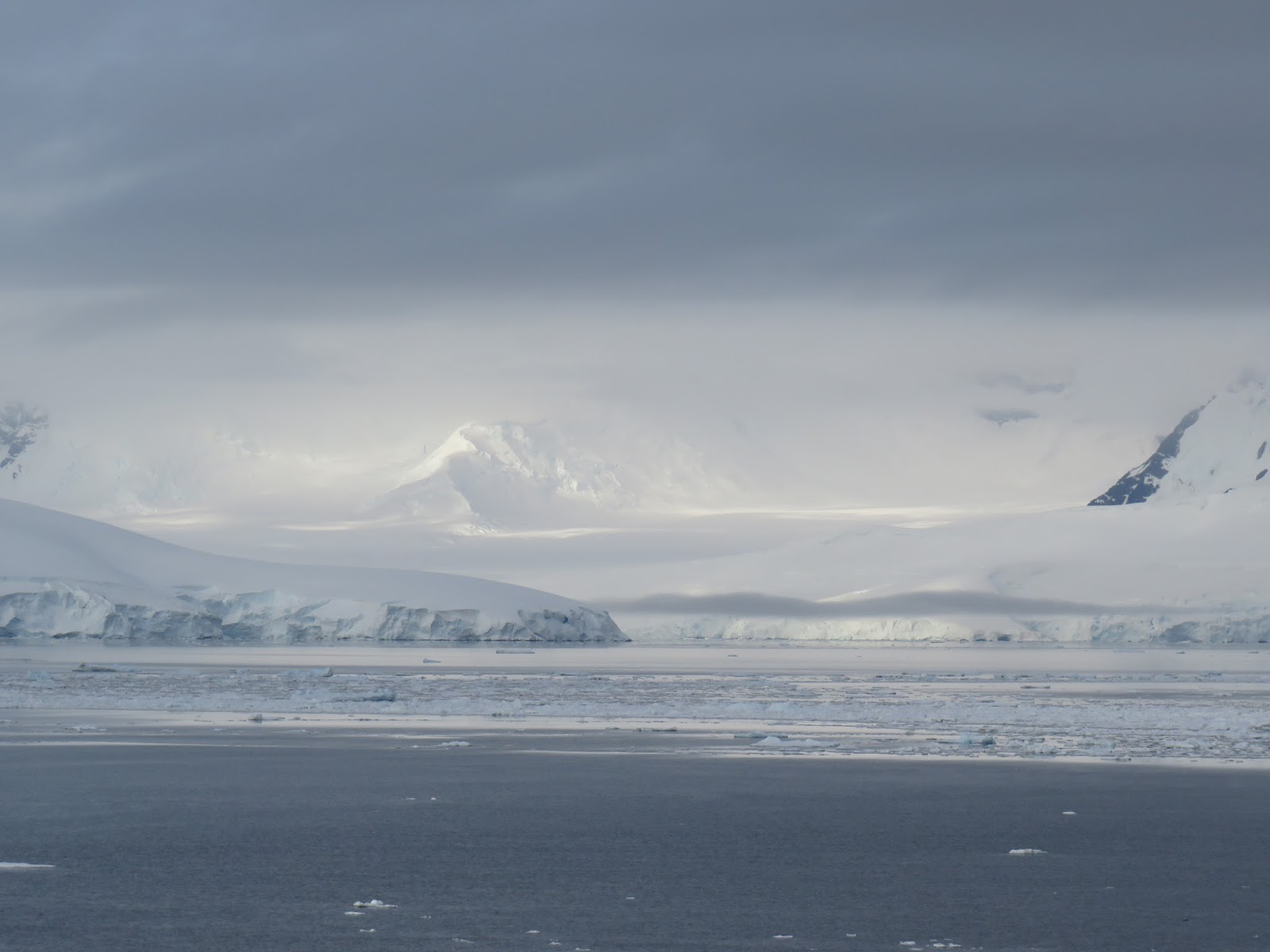
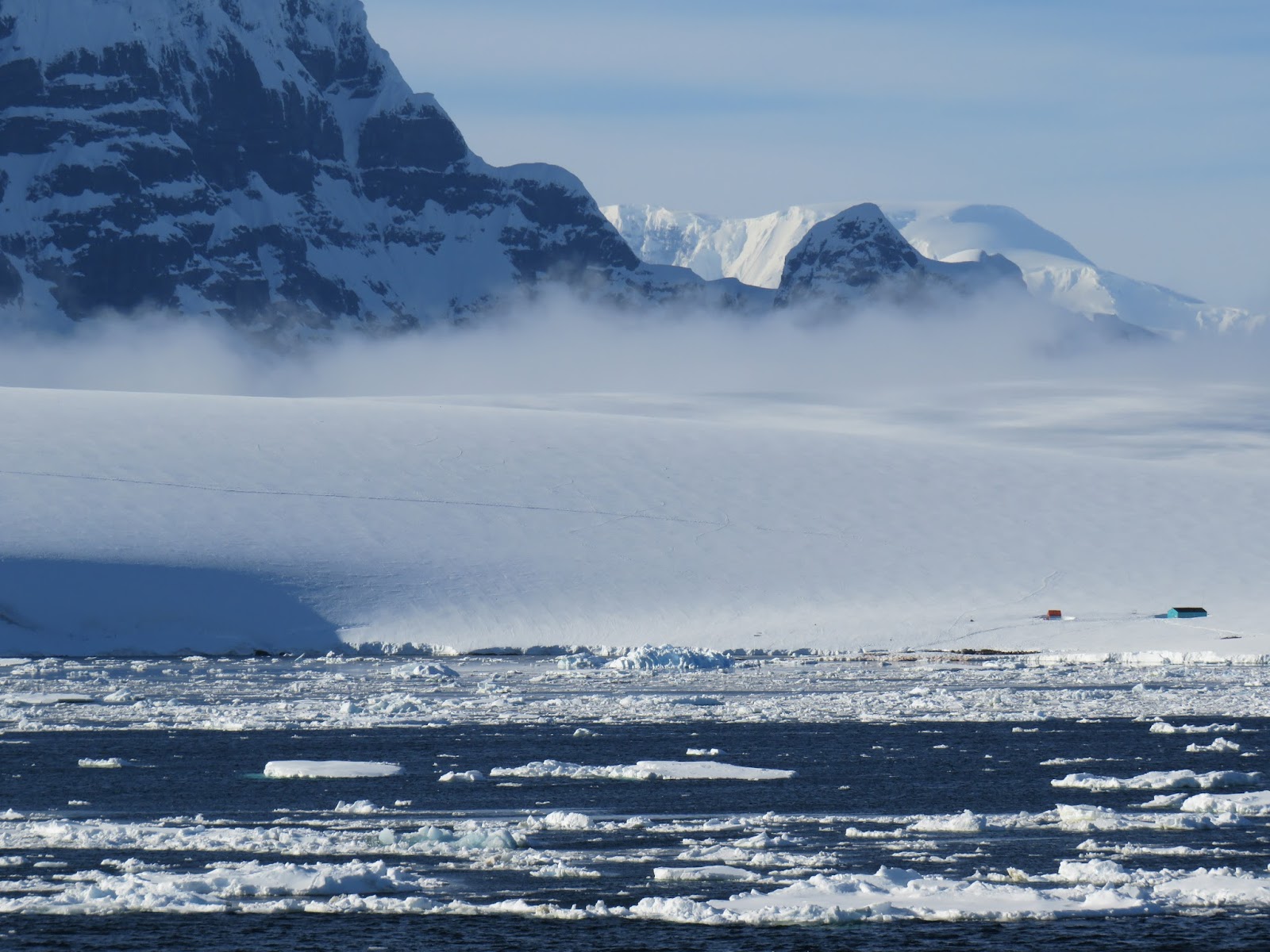
The scenery was like watching black and white television, with the occasional bright blue - that was within the icebergs floating past - it really was fantastic! There were more glaciers; hundreds of black and white striped mountains and the ocean remained a flat, reflective millpond. We zigzagged in-between small-uninhabited islands, so close that it felt as if we were going to collide with them! It was a very relaxing few hours cruising through this area. We dropped anchor just off Ytre Noskoya, (an area well known for the number of graves and monuments dedicated to the whalers); and the expedition team went onto the island to check if it was safe. I went to my cabin to get ready, and an announcement came over the loudspeaker – “There is a Polar Bear on the Port side at 3 o’clock”. I have never moved so fast in my life, straight up on to the deck and was lucky enough to briefly see the bear, before it was time for my group to go to the landing station.

What a hectic few minutes! We were told that it was rather rocky on the island. “Rather rocky” was an understatement! I opted for the shorter walk, but many people actually got off the boat and then immediately got back on! They didn’t really miss much; we saw a Snow Bunting, some Geese, Eiders and more Arctic Terns.

Several native plant species were pointed out to us, and we were given an elaborate talk on reindeer droppings! The last few people who were on this small island, had to be collected at the far end of the island – because a Polar Bear had arrived at the landing site, where I had been dropped off and collected only a few minutes before! After dinner the sun came out again and it was so bright that you could hardly look out of the windows. The captain told us to keep our eyes peeled for wildlife, and within minutes the ship was at a standstill again. There was a lone Polar Bear on the rock face to the starboard side of the ship. Every single person headed to that side of the ship and we all watched whilst he scrambled over boulders and jumped through the snow.


It was incredible, we watched him for well over an hour – on a perfect sunny, evening. As a climax to his show, he climbed down to the water’s edge and within a minute or so; he leapt into the freezing Arctic water. He swam and swam – further out into the open ocean – until we could see him no more! One theory was that he was going all the way to Greenland!

The sun was still high in the sky, shining on the mountains in the distance – with their zebra stripes and you couldn’t help feeling like you were at the top of the world. In theory we were almost at the highest point it was possible to reach safely; tomorrow, if the conditions were right, we would reach our goal – the 80th parallel. It was just past midnight as we cruised past Raudfjord, an area of picturesque red sandstone mountains that run for 20 kilometres along the coast.

I was too excited to sleep; what an amazing day it had been! Next morning, I opened my window blind to see icebergs floating past really close! We were just anchoring ready for our morning excursion – to the spectacular Monaco glacier in “The Bay of Love”.


I went on deck and watched the first few Polar Cirkle boats leave the ship and it wasn’t long before it was my turn. Even though it looked as though our ship had anchored close to the glacier, it was still a long way off. The Polar Cirkle boat sped away from the ship at a terrific speed and as we approached the glaciers’ edge, (which was about 200 metres high); we were told that we were still over half a kilometre away from it. That was unbelievable, it felt like we could just reach out and touch it!

We couldn’t safely get any closer because of calving - when large pieces of ice fall away from the front of the glacier – making icebergs. There were some impressive icebergs floating around; blue ones, brown ones, the biggest ones that I have ever seen, as well as millions of small pieces floating around us.

There were all sorts of birds flying about and some were resting on the pieces of floating ice. As for other wildlife, apparently it is never far away – our guide still had his rifle with him.

We quietly and safely glided past the front of this towering glacier, feeling completely insignificant in comparison to it. There were so many colours within the wall of ice, blues, greens, brown and red – all mixed together.

When our time was up, the driver stepped up a gear and we sped back to the ship! The sun was still shining, and we could not have had a more perfect day.

It was one of those sights you could not turn away from – or stop taking more and more photographs of – capturing yet another piece of coloured ice! I could not describe the beauty of this place and hoped my photographs would do that for me! We had a few more hours here (whilst the other passengers went out to the glacier), so I decided to have an hour in the outdoor Jacuzzi – with icebergs floating past.

I was in the arctic, everyone had coats, hats and gloves on – and I was in the Jacuzzi! It was like a dream - definitely a once-in-a-lifetime moment!

We set sail at lunchtime, heading across the Woodfjord towards our next stop - the old whaling station of Mushamna. I decided against going ashore this time, I could see the wooden trappers’ huts quite well from the boat and preferred to sit on deck scouring the surrounding area for wildlife. It wasn’t long before a northerly wind started blowing and I had a feeling that the next few hours were going to get choppy! But after dinner time, as we got closer to Moffen Island, the sea became calmer – the opposite of what I had been expecting.

It was beautiful, so serene, and peaceful. The loudspeaker system was turned off, so not to disturb the walrus colony on the island, and all that could be heard was a low hum of the ships engine.

Moffen Island is extremely flat and just looked like a black line painted on the horizon. As we got closer to it, you could see all that was on this gravelly island, was pieces of driftwood and its resident walruses.

Some of them went into the water and started swimming towards our ship, the rest were just lying next to, or on top of each other, basking in the evening sun! A bell was rung to mark the fact that we had crossed the 80th parallel and we were all given a glass of champagne. Regulations state that no one is allowed within 300 metres of Moffen Island, and I was a bit disappointed that we I couldn’t get closer, but it was a very memorable experience.

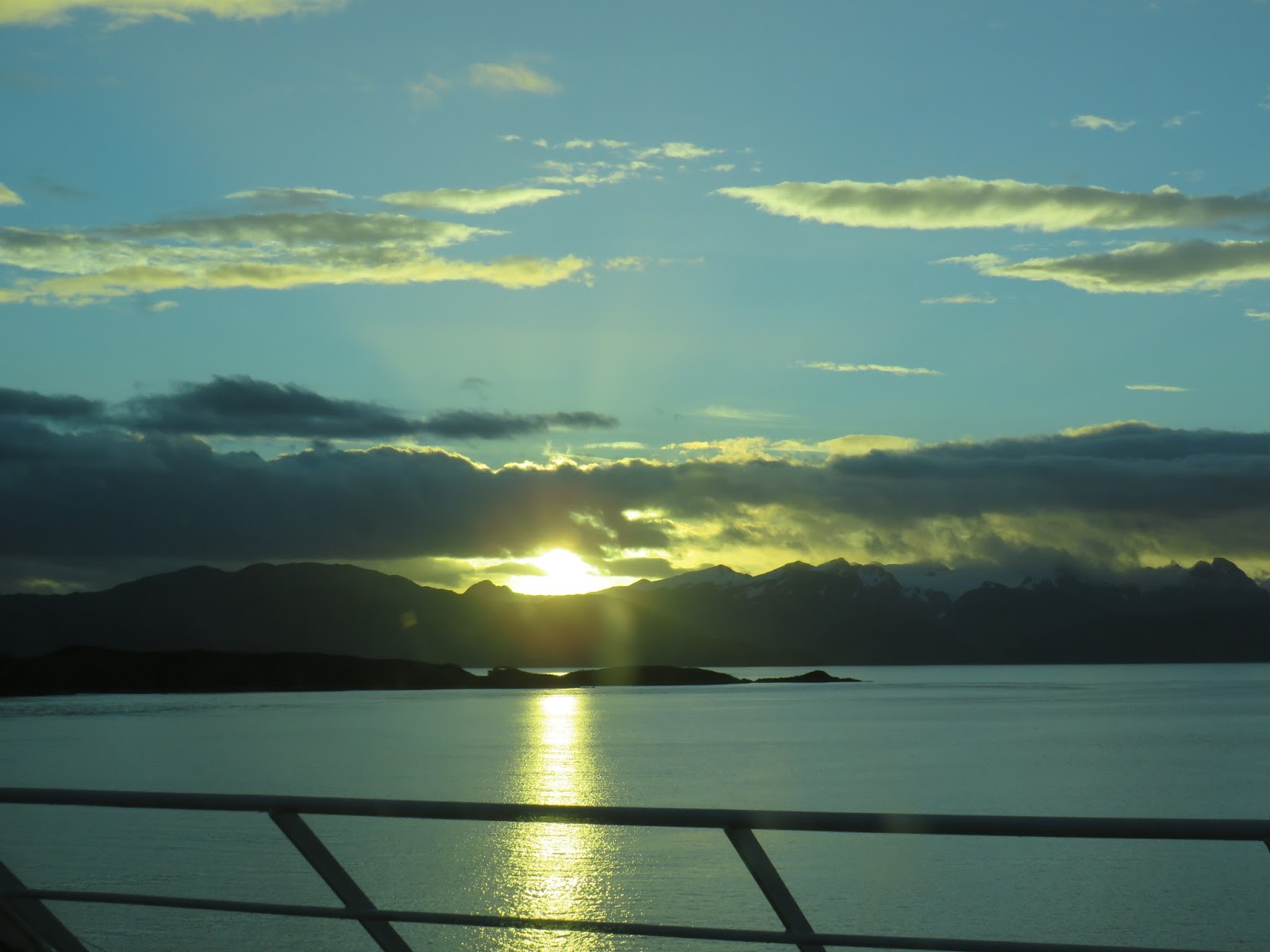
The most impressive thing about today was the calmness, stillness, and sereneness of the entire day – from the Bay of Love to the high Arctic Ocean. It had been another one of those special days, I didn’t think anything could top yesterday, but being in a Jacuzzi, in the arctic surrounded by icebergs was something else! It was now nearly midnight, although you would not know it without looking at a clock; the sun was so high in the sky! The ship turned around, a full 180 degrees; and we began heading south. When I woke the next morning and looked out of my window, there were no surprises - it was windy, raining and the sea looked (and felt) very rough. I went up to the Panorama Lounge, and I could tell that many passengers had decided to stay in their cabins! So long as I was sitting down, I would feel all right – and could still look out of the window! There were lectures and film shows on Svalbard and Ny-Alesund – our port of call for today, which sounded far more interesting than I had been expecting. Just as the meeting ended, there was an announcement saying a Polar Bear had been spotted and we were all advised to go to Deck 5 to get the best view of him! Well, it was even better that the last sighting - we were so close this time! This Bear kept going into the water and then getting back out, walking along the beach, chasing a seal, and then having another swim.

What a show he put on for us, I could not believe what I was seeing, it was like something from a Wildlife programme – but this was real. You cannot imagine how it makes you feel to see such a sight, in its own environment, a rare event - even up here. At lunchtime we arrived at Ny-Alesund – the most northerly, permanent inhabited settlement on earth! It was originally a small mining town, but from 1962 it has been home to the International Arctic Environmental Research Centre, and its researchers. Ny-Alesund has the world’s most northerly post office, which was only opened in 1974; before this any mail came by ship or was “dropped” from planes!

There is only one shop in the town, a wooden hut that sells essentials, as well as souvenirs. There were many birds about, and they were so used to humans that they happily walked along side of you – especially the Geese. The backdrop to this town was far more picturesque than I had expected. The coloured moss and pink flowers that covered the ground in front of the small lake, with the glaciers behind – made a picture postcard scene.

We were told to stay inside the town limit, an area of about 200 metres in each direction; and our guides were standing at the outer limits with their rifles again. The only buildings that are here now, house researchers – each building associated with a different country. The only other interesting building is the mining museum, which is also home to the resident dentist/doctor!

I spotted a seal very close to the shore; lots more Arctic terns – attacking people as usual, and a family of wild Arctic foxes living under one of the houses. The cubs were so cute, I would have expected them to be white, but when they are young, they are nearly black.

Their mother was even stranger – she was white with broad black stripes on her back – she had been out hunting and came running back over to her family.

There were many icebergs floating by, even bigger and bluer than the ones we had already seen – apparently the summer melt had given way to larger chunks of ice falling off. We set sail at 4pm, for the last part of our journey – back to Longyearbyen. The rain was beating down, the swell of the ocean was bigger than we had, had all of the trip and the fog was so thick that you couldn’t see anything! We were out in the open ocean and it was really rough. I managed to go for dinner, but then had to go to have a lie down for a few hours – as did most of the other passengers! When I got back to my cabin, there was a Certificate to say I had crossed the 80th Parallel and a DVD that had been made of the highlights of this trip. The swell of the ocean died down slightly about 9.30pm, so I went to the lounge and watched the Farewell Show the crew put on for us. It was an amateur production by the Philippines and Russian crew – and it did make everyone laugh. Just imagine large Russian boiler men, dressed in ladies undergarments – dancing to Lady Gaga’s “Pokerface”…………it was hysterical! When the show finished it was approaching midnight, I went to my cabin to get sorted out. I wasn’t going to sleep, as I was getting off the ship at 2am. It was a pity the weather had turned so awful, but we couldn’t complain because we had, had the right weather when it mattered - and we were in the Arctic! We docked right on schedule, and within 10 minutes I was at the airport heading home. I had a big grin on my face – I had been there, seen it all and got a keepsake Hurtigruten jacket to prove it - what an adventure it had been!

The mountains were completely different to anything I had ever seen - the snow on top of them came down the sides in uniformed patterns, covering the granite rock beneath. The water of the fjord was mirrorlike, with countless shades of blue and green mixed together.

It was one of the most picturesque sights at an airport I have ever seen! I was expecting a dull, drab place – nothing like this magnificent, impressive scenery. I was taken to the Spitsbergen Hotel “On the Hill” with fabulous views down into Longyearbyen, as well as above - to the Lars and Longyear Glacier. Unusually everyone had to take their shoes or boots off when they entered the hotel – and leave them by the front door! After a welcome meeting I decided to go exploring!

Different coloured wooden houses were built in rows like barracks; and there were hardly any cars about, but every house had skis and skidoos outside (together with sledges/trailers).


The sides of the road (a track really) was dotted with bog cotton and small yellow flowers (Svalbard Poppy) growing out of the shingle. There was a stuffed Polar Bear by some shops; and I hoped that, that wouldn’t be the only one that I saw on this trip!

Longyearbyen is the largest town on the island of Spitsbergen; home to mainly miners and researchers from all around the world. Spitsbergen used to be the name of the whole area, but it is now the name of the largest island of the Svalbard Archipelago. It is 1000 kilometres from the North Pole, at a similar latitude to the most northern point on Greenland – the most northerly habited place on earth. At the time of year I went, (July) it was permanently light - from 19th April until 23rd August. After dinner, as it still looked as though it was the middle of the day, I went another walk - up the hill this time. I had been told to keep within the town limits, due to constant danger from Polar Bears - if you went any further than this you were advised to carry a firearm. The local newspaper had reported a Polar Bear came down to the town only last week and had been scared off, with warning shots by the local police. Although I was still within these limits, there was hardly anyone about and I did feel slightly nervous. I headed up the steep hill towards some coloured buildings. Below the glacier ahead, I could see remnants of a ramshackled old mine – looking as though it could topple down at any minute.

I reached the buildings, which were hostels, and realised this was the edge of town. The road had just stopped, and all that was left ahead was shale, shingle and skidoos - parked up for the summer! I could not believe this was the outskirts of the town. I didn’t hang about; I took some photographs and started back down the hill - following the meltwater gushing down from the glaciers above. The day had been so much more interesting than I expected, and now I couldn’t wait for tomorrow. I closed my curtains at 10.30pm; it could have been lunchtime – thank goodness for blackout curtains! When I woke the next morning, I thought I was dreaming! There were two stumpy-legged Svalbard reindeer outside my bedroom window.

After breakfast I walked all the way down the hill, passing a church and a strange metal looking building – that reminded me of “Star Wars” – something from the old mines!

I headed to where several ships were moored and kept going along the track leading out of town. There were so many birds - eider ducks, geese, gulls and Arctic Terns (nesting only a few feet from the path). They had flown all the way from Antarctica to breed and were protecting their nests ferociously - proving a real problem – they kept being dive bombing me.

I ventured as far as one of the husky dog compounds before the weather turned, and a cold wind began blowing; so, I headed back to my hotel just in time for lunch; and then joined the afternoon guided coach tour. We visited the Polar Museum, with replicas of life-sized Arctic animals, as well as exhibitions on wildlife, mining, history and conservation. We were also taken a drive, stopping on the outskirts of town, and saw a road sign with a Polar bear on it!

The last stop was a Gallery containing impressive paintings of the region, as well as unusual handmade souvenirs. The Guide told us that all the buildings were built on metal poles, with the floor level 10 feet off the ground. They had to be built this way due to the constant permafrost in the ground and I thought it was to let the melting water run underneath them! The tour ended at 5pm, when it was time to board our ship the MS Fram.

This ship was built in 2007 and was well equipped with many modern amenities including a fabulous observation lounge, a gym, a sauna and 2 outdoor heated Jacuzzis! It was named after the strongest wooden exploration ship ever built – the Fram (used by the explorer Amundsen in the late 19th century). Today’s ship is only 114 metres long, rather small in comparison with luxury liners, but this ship is built for expeditions – not relaxation and pampering. All of its 225 passengers had come for an adventure and after our welcome briefing, we were all given with a new jacket, and were excited about what was in store for us. We set sail at 6pm, and after 3 hours sailing down the calm Icefjord, we arrived at the old Russian coal-mining town of Barentsberg. A town is probably the wrong word, as it only consists of a few hostel-type buildings, a hotel, a museum and a souvenir shop.

The ship docked at the quayside and after walking up 260 steps, we were given an introduction by a Ukranian Guide and shown the main buildings. It was a dreary place and even though some buildings were only 20 years old – they looked 120 years old - run down old wrecks, resembling a deserted Soviet town.

The brightest and most memorable things were pictures of people and forests, painted on the walls of some buildings. We left Barentsberg at 11.30pm and it was so peaceful and relaxing; even though it was nearly midnight it was still bright! We exited the Icefjord, into the open ocean and sailed along the coast of Prins Karl Forland heading north. Next morning, I was up at early and headed to the observation lounge, joining other people looking out for anything of interest. The coastline was tall, steep, mysterious granite mountains, obscured by low cloud, with massive glaciers in between them.

There were many different varieties of birds about; some flying alone like the fulmar - and flocks of auks, gulls and guillemots. We were heading for the far northwest corner of Svalbard, an area discovered by William Barents in 1596, which soon became one of the most popular whaling places in the world. Unfortunately, the bowhead whale was hunted so extensively in these parts, that it was extinct within 60 years. After breakfast we dropped anchor in Magdalenafjord, the best know fjord in Svalbard, renowned for its beauty; a very deep fjord, surrounded by jagged, dramatic snow-covered mountains.

The water was the most beautiful shade of turquoise, bejewelled with thousands of icebergs, and as calm and flat as a mirror. I could hardly believe it - I was expecting choppy seas! The expedition crew launched one of the Polar Cirkle boats at an area known as Trinity Bay and went onto the beach, to inspect if it was safe to go ashore.


Each crew member had a rifle and knew how to use it! After the surveillance, we were allowed to go ashore in small groups, but had to keep between armed guides at the front and back of each group.

All of a sudden there was an almighty roar – it wasn’t an animal - but a rockslide from the mountain just above us. We were shown remains of the old blubber ovens, learned about the history of whaling in this area; and saw a mound which was one of the largest concentrations of whaler’s graves on the island. It was difficult walking on the beach - a type of shingle, but with huge stones and boulders.

Some Arctic Terns had begun nesting close by, and our guide told us to walk close to the waters edge, whilst he fended off the attacking birds! We had an interesting walk for a little over an hour, after which we were told that we could go for a swim if we wanted to (it was only 2 degrees)! After lunch, we set sail again – leaving this beautiful place, still heading north.

The scenery was like watching black and white television, with the occasional bright blue - that was within the icebergs floating past - it really was fantastic! There were more glaciers; hundreds of black and white striped mountains and the ocean remained a flat, reflective millpond. We zigzagged in-between small-uninhabited islands, so close that it felt as if we were going to collide with them! It was a very relaxing few hours cruising through this area. We dropped anchor just off Ytre Noskoya, (an area well known for the number of graves and monuments dedicated to the whalers); and the expedition team went onto the island to check if it was safe. I went to my cabin to get ready, and an announcement came over the loudspeaker – “There is a Polar Bear on the Port side at 3 o’clock”. I have never moved so fast in my life, straight up on to the deck and was lucky enough to briefly see the bear, before it was time for my group to go to the landing station.

What a hectic few minutes! We were told that it was rather rocky on the island. “Rather rocky” was an understatement! I opted for the shorter walk, but many people actually got off the boat and then immediately got back on! They didn’t really miss much; we saw a Snow Bunting, some Geese, Eiders and more Arctic Terns.

Several native plant species were pointed out to us, and we were given an elaborate talk on reindeer droppings! The last few people who were on this small island, had to be collected at the far end of the island – because a Polar Bear had arrived at the landing site, where I had been dropped off and collected only a few minutes before! After dinner the sun came out again and it was so bright that you could hardly look out of the windows. The captain told us to keep our eyes peeled for wildlife, and within minutes the ship was at a standstill again. There was a lone Polar Bear on the rock face to the starboard side of the ship. Every single person headed to that side of the ship and we all watched whilst he scrambled over boulders and jumped through the snow.


It was incredible, we watched him for well over an hour – on a perfect sunny, evening. As a climax to his show, he climbed down to the water’s edge and within a minute or so; he leapt into the freezing Arctic water. He swam and swam – further out into the open ocean – until we could see him no more! One theory was that he was going all the way to Greenland!

The sun was still high in the sky, shining on the mountains in the distance – with their zebra stripes and you couldn’t help feeling like you were at the top of the world. In theory we were almost at the highest point it was possible to reach safely; tomorrow, if the conditions were right, we would reach our goal – the 80th parallel. It was just past midnight as we cruised past Raudfjord, an area of picturesque red sandstone mountains that run for 20 kilometres along the coast.

I was too excited to sleep; what an amazing day it had been! Next morning, I opened my window blind to see icebergs floating past really close! We were just anchoring ready for our morning excursion – to the spectacular Monaco glacier in “The Bay of Love”.


I went on deck and watched the first few Polar Cirkle boats leave the ship and it wasn’t long before it was my turn. Even though it looked as though our ship had anchored close to the glacier, it was still a long way off. The Polar Cirkle boat sped away from the ship at a terrific speed and as we approached the glaciers’ edge, (which was about 200 metres high); we were told that we were still over half a kilometre away from it. That was unbelievable, it felt like we could just reach out and touch it!

We couldn’t safely get any closer because of calving - when large pieces of ice fall away from the front of the glacier – making icebergs. There were some impressive icebergs floating around; blue ones, brown ones, the biggest ones that I have ever seen, as well as millions of small pieces floating around us.

There were all sorts of birds flying about and some were resting on the pieces of floating ice. As for other wildlife, apparently it is never far away – our guide still had his rifle with him.

We quietly and safely glided past the front of this towering glacier, feeling completely insignificant in comparison to it. There were so many colours within the wall of ice, blues, greens, brown and red – all mixed together.

When our time was up, the driver stepped up a gear and we sped back to the ship! The sun was still shining, and we could not have had a more perfect day.

It was one of those sights you could not turn away from – or stop taking more and more photographs of – capturing yet another piece of coloured ice! I could not describe the beauty of this place and hoped my photographs would do that for me! We had a few more hours here (whilst the other passengers went out to the glacier), so I decided to have an hour in the outdoor Jacuzzi – with icebergs floating past.

I was in the arctic, everyone had coats, hats and gloves on – and I was in the Jacuzzi! It was like a dream - definitely a once-in-a-lifetime moment!

We set sail at lunchtime, heading across the Woodfjord towards our next stop - the old whaling station of Mushamna. I decided against going ashore this time, I could see the wooden trappers’ huts quite well from the boat and preferred to sit on deck scouring the surrounding area for wildlife. It wasn’t long before a northerly wind started blowing and I had a feeling that the next few hours were going to get choppy! But after dinner time, as we got closer to Moffen Island, the sea became calmer – the opposite of what I had been expecting.

It was beautiful, so serene, and peaceful. The loudspeaker system was turned off, so not to disturb the walrus colony on the island, and all that could be heard was a low hum of the ships engine.

Moffen Island is extremely flat and just looked like a black line painted on the horizon. As we got closer to it, you could see all that was on this gravelly island, was pieces of driftwood and its resident walruses.

Some of them went into the water and started swimming towards our ship, the rest were just lying next to, or on top of each other, basking in the evening sun! A bell was rung to mark the fact that we had crossed the 80th parallel and we were all given a glass of champagne. Regulations state that no one is allowed within 300 metres of Moffen Island, and I was a bit disappointed that we I couldn’t get closer, but it was a very memorable experience.

The most impressive thing about today was the calmness, stillness, and sereneness of the entire day – from the Bay of Love to the high Arctic Ocean. It had been another one of those special days, I didn’t think anything could top yesterday, but being in a Jacuzzi, in the arctic surrounded by icebergs was something else! It was now nearly midnight, although you would not know it without looking at a clock; the sun was so high in the sky! The ship turned around, a full 180 degrees; and we began heading south. When I woke the next morning and looked out of my window, there were no surprises - it was windy, raining and the sea looked (and felt) very rough. I went up to the Panorama Lounge, and I could tell that many passengers had decided to stay in their cabins! So long as I was sitting down, I would feel all right – and could still look out of the window! There were lectures and film shows on Svalbard and Ny-Alesund – our port of call for today, which sounded far more interesting than I had been expecting. Just as the meeting ended, there was an announcement saying a Polar Bear had been spotted and we were all advised to go to Deck 5 to get the best view of him! Well, it was even better that the last sighting - we were so close this time! This Bear kept going into the water and then getting back out, walking along the beach, chasing a seal, and then having another swim.

What a show he put on for us, I could not believe what I was seeing, it was like something from a Wildlife programme – but this was real. You cannot imagine how it makes you feel to see such a sight, in its own environment, a rare event - even up here. At lunchtime we arrived at Ny-Alesund – the most northerly, permanent inhabited settlement on earth! It was originally a small mining town, but from 1962 it has been home to the International Arctic Environmental Research Centre, and its researchers. Ny-Alesund has the world’s most northerly post office, which was only opened in 1974; before this any mail came by ship or was “dropped” from planes!

There is only one shop in the town, a wooden hut that sells essentials, as well as souvenirs. There were many birds about, and they were so used to humans that they happily walked along side of you – especially the Geese. The backdrop to this town was far more picturesque than I had expected. The coloured moss and pink flowers that covered the ground in front of the small lake, with the glaciers behind – made a picture postcard scene.

We were told to stay inside the town limit, an area of about 200 metres in each direction; and our guides were standing at the outer limits with their rifles again. The only buildings that are here now, house researchers – each building associated with a different country. The only other interesting building is the mining museum, which is also home to the resident dentist/doctor!

I spotted a seal very close to the shore; lots more Arctic terns – attacking people as usual, and a family of wild Arctic foxes living under one of the houses. The cubs were so cute, I would have expected them to be white, but when they are young, they are nearly black.

Their mother was even stranger – she was white with broad black stripes on her back – she had been out hunting and came running back over to her family.

There were many icebergs floating by, even bigger and bluer than the ones we had already seen – apparently the summer melt had given way to larger chunks of ice falling off. We set sail at 4pm, for the last part of our journey – back to Longyearbyen. The rain was beating down, the swell of the ocean was bigger than we had, had all of the trip and the fog was so thick that you couldn’t see anything! We were out in the open ocean and it was really rough. I managed to go for dinner, but then had to go to have a lie down for a few hours – as did most of the other passengers! When I got back to my cabin, there was a Certificate to say I had crossed the 80th Parallel and a DVD that had been made of the highlights of this trip. The swell of the ocean died down slightly about 9.30pm, so I went to the lounge and watched the Farewell Show the crew put on for us. It was an amateur production by the Philippines and Russian crew – and it did make everyone laugh. Just imagine large Russian boiler men, dressed in ladies undergarments – dancing to Lady Gaga’s “Pokerface”…………it was hysterical! When the show finished it was approaching midnight, I went to my cabin to get sorted out. I wasn’t going to sleep, as I was getting off the ship at 2am. It was a pity the weather had turned so awful, but we couldn’t complain because we had, had the right weather when it mattered - and we were in the Arctic! We docked right on schedule, and within 10 minutes I was at the airport heading home. I had a big grin on my face – I had been there, seen it all and got a keepsake Hurtigruten jacket to prove it - what an adventure it had been!
Thank you for taking time to follow my adventures,
Lynne
These are my other blogs :-